If you're facing a total knee replacement, one of the most important questions you can ask your surgeon is: "How will you get to the knee joint?" The answer to this question has a direct impact on how quickly you recover, how much pain you experience, and how soon you can return to the activities you love.
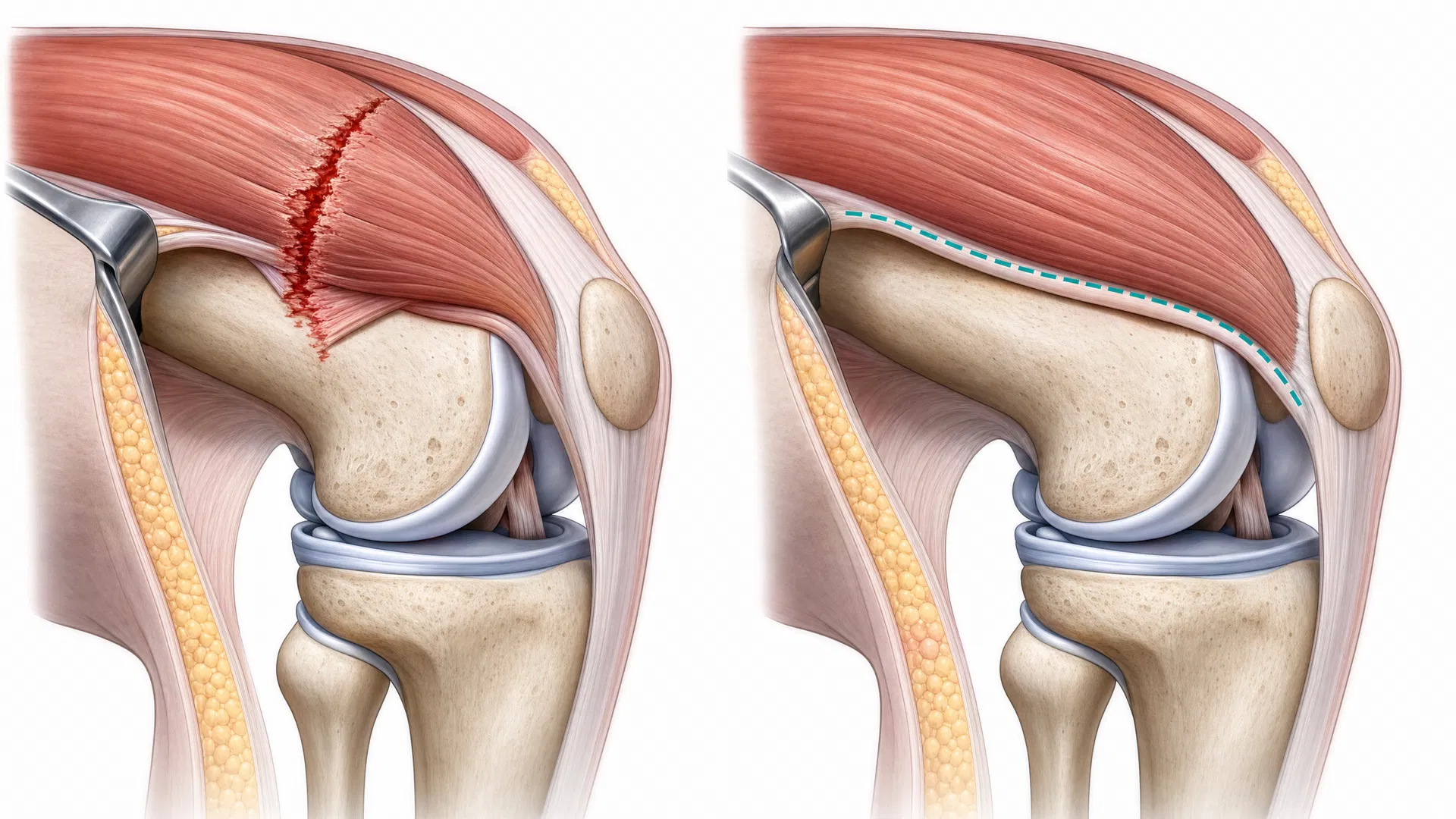
For over 90 years, the standard approach to total knee replacement has been the medial parapatellar approach — a technique that requires cutting directly through the quadriceps tendon to access the knee joint. While effective, this approach damages the very muscle you need most for recovery: the quadriceps. It's the muscle that straightens your knee, helps you walk, climb stairs, and get out of a chair.
There is a better way. The subvastus approach — also called the muscle-sparing approach — goes underneath the quadriceps muscle rather than cutting through it. And the science is clear: patients who have their knee replaced through this approach recover faster, experience less pain, and regain muscle strength sooner.
What Is the Subvastus Approach?
The subvastus approach was first described in 1929 and popularized by Dr. Hofmann in 1991. Instead of making an incision through the quadriceps tendon (as in the traditional approach), the surgeon enters the knee joint by going underneath the vastus medialis muscle — the inner portion of the quadriceps that sits just above the kneecap.
By preserving the quadriceps mechanism, the subvastus approach maintains the blood supply to the kneecap, preserves the extensor mechanism, and avoids the scar tissue formation that occurs when muscle and tendon are cut and must heal back together.
Dr. Lupo performs an enhanced medial oblique modified version of the subvastus approach that he has developed to work specifically with the MAKO robotic system. This refinement allows for optimal robotic access while maximizing muscle preservation — combining the precision of robotic-arm assisted surgery with the recovery benefits of a muscle-sparing technique.
What the Research Shows
The evidence supporting the subvastus approach is substantial. Multiple randomized controlled trials and meta-analyses — the highest levels of medical evidence — have consistently demonstrated faster early recovery with this technique.
Meta-Analysis: 20 Randomized Controlled Trials (1,893 Knees)
Berstock et al., EFORT Open Reviews, 2018
This comprehensive meta-analysis pooled data from 20 randomized controlled trials comparing the subvastus approach to the traditional medial parapatellar approach. The findings were clear:
- •Straight leg raise recovered 1.7 days sooner — a critical early milestone that determines when patients can safely walk independently
- •Significantly less pain on day one (0.8 points lower on a 10-point pain scale)
- •7 degrees more range of motion at one week — meaning patients could bend their knee further, sooner
- •57 mL less blood loss during surgery
- •No difference in complication rates — the approach is equally safe
Prospective Study: 180 Patients — Faster Milestones Across the Board
Thienpont, Knee Surgery, Sports Traumatology, Arthroscopy, 2013
This study compared a far medial subvastus approach to a mini-parapatellar approach in 180 patients and found:
- •Straight leg raise achieved in 1.7 days vs. 2.7 days with the traditional approach
- •Walking without assistance by day 1.7 vs. day 2.0
- •Stair climbing by day 3 vs. day 4
- •Hospital discharge one full day earlier (4 days vs. 5 days)
- •Identical long-term outcomes at 24 months — same Knee Society Scores
MAKO Robotic + Modified Subvastus: The Best of Both Worlds
Fan et al., Journal of Orthopaedic Surgery and Research, 2026
This recent study of 275 patients compared three groups: MAKO robot-assisted modified subvastus, conventional subvastus, and the traditional medial parapatellar approach. The combination of robotics with the muscle-sparing approach produced the best results:
- •Best prosthesis alignment accuracy with the lowest outlier rate
- •Better pain scores, range of motion, and function at both day 1 and day 14
- •Less muscle damage (measured by lower creatine kinase levels — a blood marker of muscle injury)
- •Faster quadriceps strength recovery within 30 days of surgery
The researchers concluded that combining robotic precision with a muscle-sparing approach "aligns with the enhanced recovery after surgery concept and merits clinical application."
View Study10-Year Follow-Up: Faster Recovery Without Sacrificing Long-Term Results
Hosseini-Monfared et al., Journal of Experimental Orthopaedics, 2024
One concern patients sometimes have is whether a different surgical approach might compromise long-term results. This 10-year follow-up study put that concern to rest:
- •Significantly faster straight leg raise in the subvastus group (p<0.001)
- •Better pain and function scores at 1 year
- •Identical long-term outcomes at 10+ years — same WOMAC and Knee Society Scores
The bottom line: you get faster recovery in the short term without sacrificing anything in the long term.
View StudyWhy Does This Matter for Your Recovery?
The quadriceps muscle is the engine of your knee. It's what allows you to straighten your leg, stand up from a chair, walk up stairs, and maintain your balance. When a surgeon cuts through this muscle or its tendon to access the knee joint, that muscle must heal before it can function normally again. During that healing period, patients experience weakness, difficulty with basic tasks, and pain.
By going underneath the muscle — preserving its fibers, its blood supply, and its attachment to the kneecap — the subvastus approach allows the quadriceps to begin working immediately after surgery. This is why patients who have their knee replaced through this approach can typically:
If It's Better, Why Don't All Surgeons Use It?
Despite the clear evidence, the subvastus approach is used in only about 1% of total knee replacements in the United States and United Kingdom. There are several reasons for this:
It's technically more demanding. The subvastus approach provides a smaller surgical window, requiring more skill and experience to perform safely. Most surgeons are trained on the traditional approach during residency and never learn the subvastus technique.
It requires higher surgical volume. Like any advanced technique, proficiency comes with repetition. Surgeons who perform a high volume of robotic knee replacements can develop the expertise needed to consistently execute this approach with precision.
Robotics makes it more accessible. The MAKO robotic system's precision actually complements the subvastus approach — the robot's accuracy means the surgeon can work within a smaller window without compromising implant positioning. This is why the 2026 study by Fan et al. found that the combination of MAKO robotics with the modified subvastus approach produced the best alignment accuracy of all three groups studied.
Dr. Lupo's MAKO Muscle Sparing Approach
Dr. Lupo uses an enhanced medial oblique modified subvastus approach adapted for the MAKO robotic system. The approach reaches the knee beneath the quadriceps with the goal of preserving the extensor mechanism while robotic guidance supports the surgical plan.
With over 3,000 robotic joint replacements performed, Dr. Lupo has the surgical volume and expertise that the research shows is essential for consistently executing this technically demanding approach. His patients routinely achieve same-day discharge, with 95% going home the day of surgery.
The procedure is performed locally at AHN Saint Vincent Hospital in Erie, with consultation and follow-up coordinated through the AHN Orthopaedic Institute.
Key Takeaways
- 1The subvastus approach preserves the quadriceps muscle by going underneath it rather than cutting through it.
- 2Meta-analyses of 20+ randomized trials confirm faster recovery, less pain, and better early range of motion.
- 3Long-term outcomes (10+ years) are identical — you get faster recovery without sacrificing anything.
- 4Combining the subvastus approach with MAKO robotics produces the best alignment accuracy AND the fastest muscle recovery.
- 5Only ~1% of knee replacement surgeons use this approach — it requires high volume and advanced skill.
References
- Berstock JR, Murray JR, Whitehouse MR, Blom AW, Beswick AD. Medial subvastus versus the medial parapatellar approach for total knee replacement: A systematic review and meta-analysis of randomized controlled trials. EFORT Open Reviews. 2018;3(3):78-84. PMC5890136
- Thienpont E. Faster quadriceps recovery with the far medial subvastus approach in total knee arthroplasty. Knee Surgery, Sports Traumatology, Arthroscopy. 2013;21(10):2370-2374. PMID: 23007414
- Fan Y, Jiang L, Chen Z, Wang C. Comparison of robot-assisted modified subvastus approach versus medial parapatellar approach in total knee arthroplasty: a retrospective cohort study. Journal of Orthopaedic Surgery and Research. 2026;21:81. PMC12866314
- Hosseini-Monfared P, et al. Comparable long-term functional outcomes of subvastus and medial parapatellar approach in total knee arthroplasty: A 10-year follow-up study. Journal of Experimental Orthopaedics. 2024;11(4):e70035. PMC11460747
- Stubnya BG, Kocsis K, Vancsa S, Kovacs K, et al. Subvastus approach supporting fast-track total knee arthroplasty over the medial parapatellar approach: a systematic review and network meta-analysis. The Journal of Arthroplasty. 2023.
- Migliorini F, Aretini P, Driessen A, El Mansy Y, et al. Better outcomes after mini-subvastus approach for primary total knee arthroplasty: a Bayesian network meta-analysis. European Journal of Orthopaedic Surgery & Traumatology. 2020.
- Peng X, Zhang X, Cheng T, Cheng M, et al. Comparison of the quadriceps-sparing and subvastus approaches versus the standard parapatellar approach in total knee arthroplasty: a meta-analysis of randomized controlled trials. BMC Musculoskeletal Disorders. 2015;16:59.
Ready to Learn More?
If you're considering a total knee replacement and want to know whether the MAKO Muscle Sparing approach is right for you, schedule a consultation with Dr. Lupo. He'll review your imaging, discuss your goals, and explain exactly how this technique applies to your specific situation.