MAKO Muscle-Sparing Total Knee Replacement
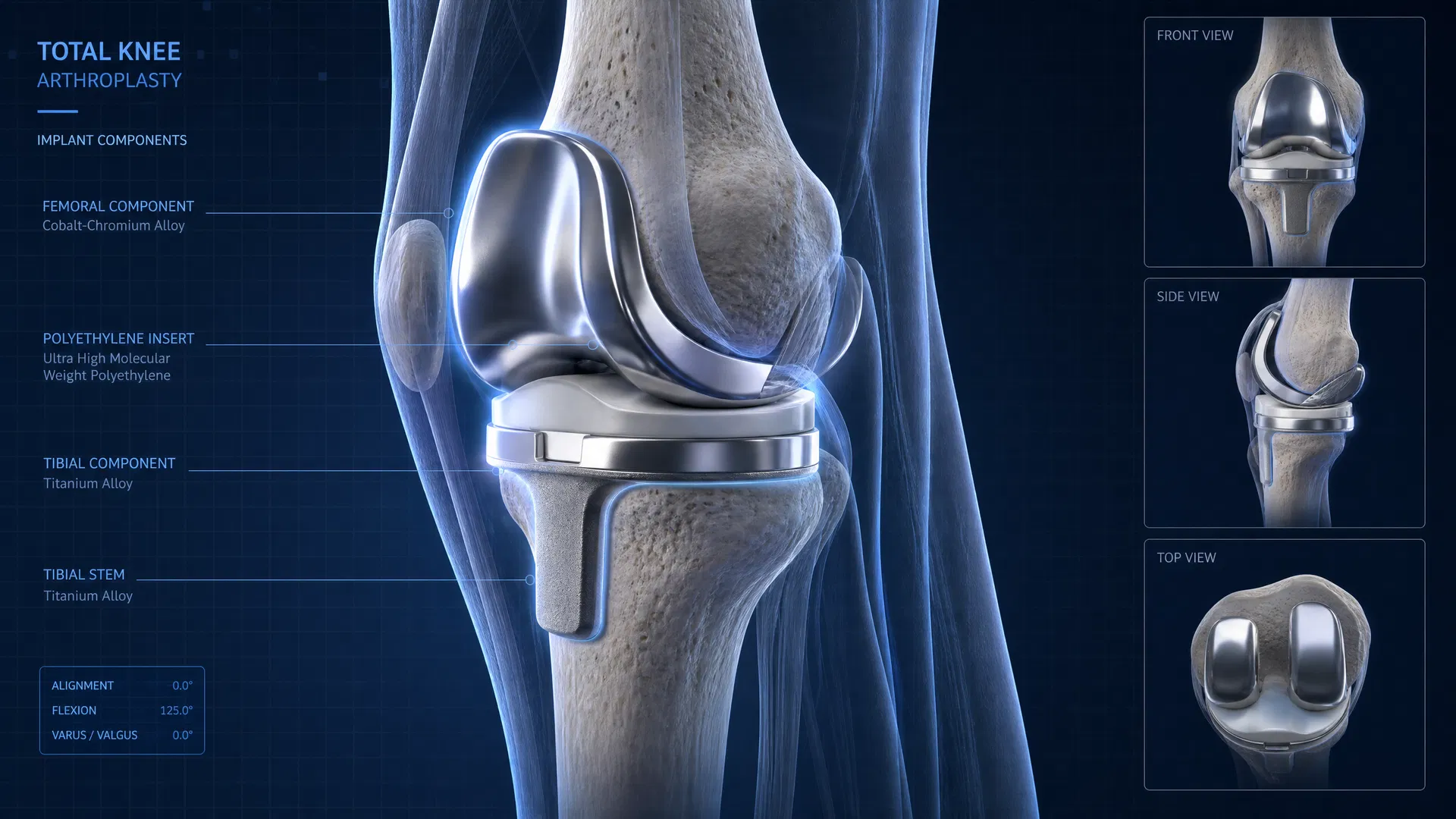
The MAKO Muscle-Sparing Total Knee uses a subvastus approach beneath the quadriceps. It preserves the quadriceps tendon—no quadriceps muscle is cut—and combines that approach with robotic-assisted planning.
Consultations are held at the AHN Orthopaedic Institute. Surgery is performed at AHN Saint Vincent Hospital's Total Joint Center in Erie.
Why the MAKO Muscle-Sparing Approach Matters
A commonly used medial parapatellar approach opens the joint through the quadriceps tendon. Dr. Lupo's subvastus approach instead reaches the joint beneath the vastus medialis, preserves the quadriceps tendon, and does not cut the quadriceps muscle.
Dr. Lupo's enhanced medial oblique modified subvastus approach works beneath the quadriceps. He has adapted and refined the approach for robotic-arm assisted planning and execution.
Robotic guidance helps Dr. Lupo execute the patient-specific plan within defined boundaries. Published research describes potential early-recovery benefits of subvastus and robotic approaches:
Common Recovery Milestones
Where Will My Knee Surgery Take Place?
Dr. Lupo performs the knee replacement procedures described here at AHN Saint Vincent Hospital's Total Joint Center in Erie. The consultation office and hospital arrival location are different, so the care team will provide the correct instructions for each visit.
Nurse Navigation
AHN describes its Saint Vincent joint replacement program as including nurse navigation from preparation through recovery.
Joint Education
AHN describes preoperative education that helps patients and families understand surgery, discharge, and recovery.
Rehabilitation Support
AHN describes rehabilitation support coordinated according to the patient's procedure and individual care plan.
Services, discharge timing, and rehabilitation arrangements vary. Your care team will explain the plan recommended for you.
How Robotic-Arm Assisted Knee Surgery Works
A personalized, CT-based surgical plan helps guide bone preparation and implant positioning during knee replacement.
3D Planning
A CT scan creates a detailed 3D model of your unique knee anatomy. Dr. Lupo plans the exact position, size, and alignment of your implant before you ever enter the operating room.
Robotic Guidance
During surgery, the robotic arm provides real-time feedback and haptic boundaries that help Dr. Lupo carry out the planned bone preparation while he controls every movement.
Precision Placement
Dr. Lupo uses robotic guidance to carry out the plan and assess alignment and ligament balance during the procedure.
What Published Studies Report
Research evaluates robotic guidance and muscle-sparing approaches across patient groups. These findings inform care but do not predict an individual's result.
55% Less Pain
Robotic-arm assisted patients reported a 55.4% lower median pain score compared to manual surgery patients from day 1 through week 8.
Source: Journal of Arthroplasty
Faster Quadriceps Recovery
The subvastus approach preserves the quadriceps mechanism, resulting in faster return of muscle strength and earlier independence — particularly in patients in their 60s.
Source: Annals of Medicine and Surgery, 2021
Higher Forgotten Joint Score
Robotic-assisted knee replacement patients report higher Forgotten Joint Scores — meaning they literally forget they have an artificial knee. The joint feels that natural.
Source: Knee Surgery, Sports Traumatology, Arthroscopy, 2023
26% Shorter Hospital Stay
Mako robotic TKA was associated with a 26% reduction in length of hospital stay, less need for in-patient physical therapy, and improved early functional recovery.
Source: Bone & Joint Journal, 2018
Less Opioid Use
Patients who underwent robotic-assisted TKA had lower opioid consumption at 90 days, 6 months, and 1 year compared to conventional surgery patients.
Source: Arthroplasty Today, 2020
Reduced Tissue Damage
Haptic-guided robotic boundaries protect surrounding bone and soft tissue during surgery, resulting in measurably less iatrogenic damage than manual techniques.
Source: Surgical Technology International, 2017
The Enhanced Robotic Workflow Difference
Dr. Lupo uses an enhanced robotic workflow that captures more data points and provides more information for accurately positioned implant plans. The vast majority of robotic surgeons use the express workflow, which provides less data. More data means better planning, better positioning, and better outcomes for you.
Robotic Partial Knee Replacement
When arthritis affects only one compartment of the knee, a partial (unicompartmental) knee replacement preserves healthy bone, cartilage, and ligaments. Robotic guidance ensures the partial implant is positioned with the same precision as a total replacement, maximizing longevity and natural feel.
Traditional vs. Muscle-Sparing Robotic Approach
Traditional Approach
- A common medial parapatellar approach opens the quadriceps tendon
- May use conventional guides, navigation, or other technology
- Alignment strategy depends on the surgeon and patient
- Pain and early function vary by patient and technique
- Quadriceps-tendon recovery may influence early function
- Discharge timing depends on medical and mobility readiness
Dr. Lupo's Approach
- Goes beneath the quadriceps; no quadriceps muscle is cut
- Robotic-arm guided precision
- CT-based, patient-specific planning
- Published studies report differences in early pain
- Recovery milestones vary by patient
- Practice-reported 95% same-day discharge among appropriately selected patients
Peer-reviewed trials and reviews report differences in some early pain and function measures between subvastus and medial parapatellar approaches. Study findings and individual recovery vary.
Knee Replacement FAQ
What is the subvastus (muscle-sparing) approach?
The subvastus approach is a surgical technique for total knee replacement that accesses the knee joint from beneath the vastus medialis muscle rather than cutting through it. This preserves the quadriceps mechanism, which is responsible for straightening your knee. Because the muscle stays intact, patients typically experience less pain and faster recovery of knee function compared to traditional approaches.
How is robotic-arm assisted surgery different from traditional knee replacement?
In traditional knee replacement, the surgeon uses manual cutting guides to position the implant. With robotic-arm assisted surgery, a CT scan creates a 3D model of your knee before surgery. The surgeon plans the exact implant position on this model, and during surgery, the robotic arm provides real-time guidance and haptic boundaries to ensure the plan is executed with sub-millimeter accuracy.
Am I a candidate for muscle-sparing robotic knee replacement?
Most patients with knee arthritis who are candidates for total knee replacement can benefit from the muscle-sparing robotic approach. During your consultation, Dr. Lupo will evaluate your specific anatomy, the severity of your arthritis, and your overall health to determine the best surgical plan for you.
Where will my knee replacement surgery take place?
Dr. Lupo performs the knee replacement procedures described on this website at AHN Saint Vincent Hospital's Total Joint Center in Erie. Your consultation occurs at the AHN Orthopaedic Institute, and the care team will give you separate hospital arrival instructions before surgery.
How long will I be in the hospital?
Many appropriately selected joint replacement patients may go home the day of surgery. Discharge timing, weight-bearing, stairs, and walking aids depend on your health, procedure, mobility, and home support. The care team will confirm your plan.
What is the difference between this approach and branded knee replacement programs?
A trademarked program name does not by itself explain the surgical approach or predict an outcome. Ask how the joint is accessed, how implant position is planned, what evidence supports the technique, and what experience the surgeon has. Dr. Lupo uses an enhanced medial oblique modified subvastus approach adapted for robotic-assisted planning.
How long does the implant last?
Modern knee implants are designed to last 20–25 years or more. The precision of robotic-arm assisted placement may extend implant longevity by ensuring optimal alignment and reducing abnormal wear patterns.
Evidence-Based: Why This Approach Works
Every claim on this page is backed by peer-reviewed research. Here are the key findings — with links to the full evidence.
The Subvastus Approach: What Studies Report
A meta-analysis of 20 randomized trials (1,893 knees) reported differences in early pain, straight-leg raise, and return to function when comparing subvastus and standard approaches. These study findings do not predict an individual patient's recovery.
MAKO Robotic Precision: Sub-Degree Accuracy for Longer-Lasting Results
The MAKO robotic arm uses a CT-based 3D model of your specific knee anatomy to plan and execute implant placement. Haptic boundaries prevent deviation from the surgical plan, achieving alignment accuracy within 1 degree. This precision means better ligament balancing, more natural knee feel, and potentially longer implant life.
Functional Alignment: Positioned for Your Body, Not a Generic Template
MAKO functional alignment uses 3D CT planning and Digital Tensioner data to account for an individual's anatomy and ligament balance. In a matched study of 128 MAKO knee replacements, the functional-alignment group reported better outcomes than the mechanical-alignment group.
Functional Alignment: Your Knee, Positioned for Your Body
Functional alignment uses patient-specific anatomy and ligament-balance information to guide implant positioning rather than applying one target identically to every knee.
What Is Functional Alignment?
For decades, surgeons aligned every knee replacement to a single "mechanical axis" — a straight line from hip to ankle. This one-size-fits-all approach often requires cutting ligaments to make your knee fit the implant, and up to 20% of patients remain dissatisfied.
Functional alignment flips this concept: instead of forcing your knee to fit the implant, the implant is positioned to fit your knee's natural ligament balance. MAKO's Digital Tensioner objectively measures your medial and lateral ligament tension in real-time, then the 3D plan adjusts bone cuts to preserve your native soft tissue envelope — without releases.
How MAKO Supports 3D Functional Alignment
Functional alignment is a 3D process. MAKO combines CT-based planning with intraoperative ligament-balance information so Dr. Lupo can evaluate position across multiple planes.
What the Research Shows: Functional vs. Mechanical Alignment with MAKO
reported no residual symptoms in the functional-alignment group (vs. 58% mechanical)
lower reported instability in the functional-alignment group (6.4% vs. 21.9%)
higher Forgotten Joint Score in the matched study (63.4 vs. 51.2)
In a matched study of 128 MAKO knee replacements, the functional-alignment group had 73% of patients reporting no residual symptoms, lower reported instability, and a higher Forgotten Joint Score than the mechanical-alignment group. Study findings do not guarantee an individual result.
Source: Michaud et al., SICOT Journal, 2024 | Bone & Joint Open, 2025 (22 studies, 3,738 TKAs) | Australian Orthopaedic Association Registry, 2024
MAKO: The Only Robotic System Proven in the Australian Registry
In the 2024 Australian Orthopaedic Association National Joint Replacement Registry — the world's largest joint registry — MAKO was the only robotic system to demonstrate a statistically significant improvement in revision rates compared to manual surgery. At 6 years, MAKO showed a 19% relative improvement in survivorship (30% when implanted with a patella). No other robotic system achieved this distinction.
Find Out If You're a Candidate
Call during office hours to schedule with Dr. Lupo and discuss whether knee replacement may be appropriate for you.