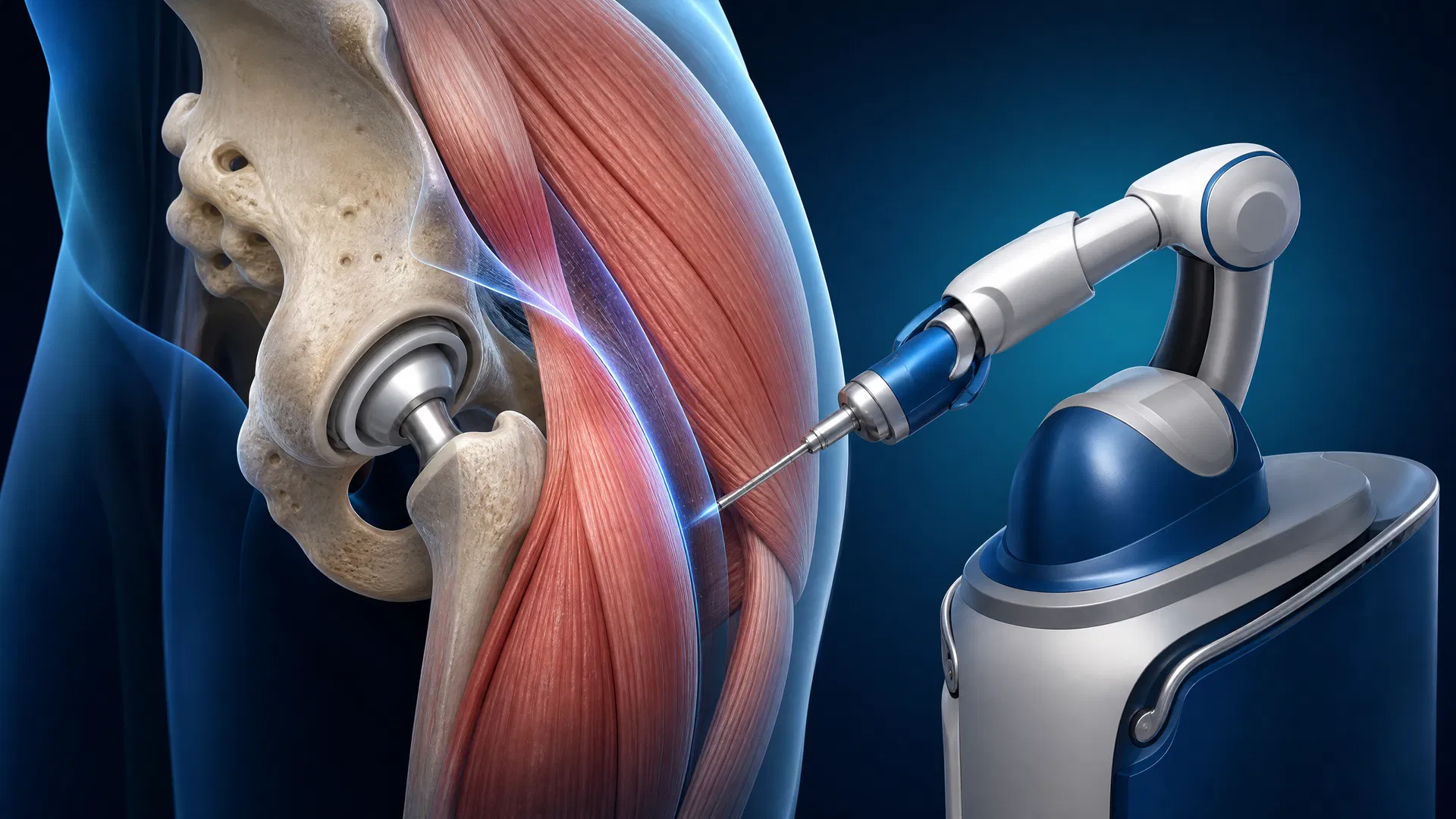
The Direct Anterior Hip: Why Going Between the Muscles Changes Everything
If you're facing hip replacement surgery, you've likely heard that "the approach matters." The direct anterior approach uses a different access route than posterior or lateral approaches. When combined with MAKO robotic guidance, it offers an evidence-informed option for patients in the Erie region, although individual recovery varies.
What Makes the Direct Anterior Approach Different?
A posterior hip approach commonly requires release and later repair of short external rotator tendons and the posterior capsule. The direct anterior approach instead uses a natural interval between muscle groups and commonly avoids routine tendon detachment.
Published studies report differences in some early-recovery measures across approaches. Mobility, precautions, and return to activity still depend on the patient's health, procedure, and care plan.
Key Advantages of the Direct Anterior Approach
What the Research Shows: Less Pain, Faster Function
The evidence supporting the direct anterior approach has grown substantially over the past decade. A comprehensive 2025 meta-analysis by Liu et al., published in the Journal of Orthopaedic Surgery and Research, analyzed 17 randomized controlled trials involving 1,575 patients. The findings were clear: patients who received the direct anterior approach experienced significantly lower pain scores on the first day after surgery (mean difference of -0.79 on the VAS scale, p<0.01) and demonstrated superior early hip function at one month, as measured by the Harris Hip Score.[1]
An even broader 2025 umbrella review — a study of studies — examined 11 separate meta-analyses of randomized controlled trials comparing the direct anterior and posterior approaches. The pooled evidence confirmed that DAA patients experienced significantly less pain on postoperative days 1 and 2, with a mean difference of -0.65 on the pain scale. Harris Hip Scores were significantly better at both 2 weeks (7.41 points higher) and 6 weeks (6.05–6.80 points higher) in the anterior group.[2]
| Study | Evidence | Key Finding |
|---|---|---|
| Liu et al. 2025 | 17 RCTs, 1,575 patients | Lower pain POD1, better function at 1 month |
| Umbrella Review 2025 | 11 meta-analyses of RCTs | Less pain days 1–2, better HHS at 2 & 6 weeks |
| Wang et al. 2018 | 9 RCTs, 754 hips | Lower VAS at 24h, 48h, 72h; less blood loss |
| Aneja et al. 2025 | Comprehensive review | Dislocation rate 0.2–0.5% vs 1–2% posterior |
| Llombart-Blanco 2024 | 12 studies, 1,224 MAKO hips | Better implant positioning in safe zones |
Dislocation Risk and Postoperative Precautions
One of the most significant advantages of the direct anterior approach is the dramatic reduction in dislocation risk. Because the posterior capsule and short external rotator muscles remain completely intact, the hip maintains its natural stability from the moment the new joint is implanted. A 2025 comprehensive review in the Journal of Orthopaedic Case Reports documented dislocation rates as low as 0.2–0.5% with the anterior approach, compared to 1–2% with the posterior approach — a reduction of up to 75–90%.[3]
Most of Dr. Lupo's direct anterior patients have no routine hip precautions. They may bend, cross their legs, and tie their shoes unless Dr. Lupo gives different instructions based on the individual surgery.
Adding MAKO Robotic Precision: The Best of Both Worlds
While the direct anterior approach addresses the soft tissue side of recovery, the MAKO robotic system addresses the precision side. A 2024 meta-analysis of 12 studies involving 1,224 MAKO-assisted hip replacements demonstrated that robotic guidance achieves significantly better implant positioning — placing components within the "safe zone" more consistently than manual techniques. The study also found improved Forgotten Joint Scores (a measure of how natural the hip feels), with a mean difference of 5.99 points favoring MAKO.[4]
Combining the direct anterior approach with MAKO's CT-based 3D planning brings soft-tissue considerations and component-position information into one surgical workflow. The technology assists the surgeon; it does not guarantee a particular recovery or implant lifespan.
What Recovery Actually Looks Like
The Wang et al. meta-analysis of 9 randomized controlled trials (754 hips) found that anterior approach patients had significantly better Harris Hip Scores at 2 weeks and 4 weeks, with significantly lower pain at 24, 48, and 72 hours after surgery. By 12 weeks, both groups achieved equivalent function — meaning the anterior approach doesn't just get you to the same destination, it gets you there faster.[5]
Typical Recovery Timeline: MAKO Muscle Sparing Direct Anterior Hip
Shorter Hospital Stays and Same-Day Discharge
The umbrella review confirmed that multiple meta-analyses found a statistically significant reduction in hospital stay with the anterior approach — ranging from 0.31 to 0.56 days shorter than the posterior approach. While half a day may sound modest, it reflects a broader trend: the direct anterior approach is highly compatible with Enhanced Recovery After Surgery (ERAS) protocols, and many patients now go home the same day as their procedure.[2]
By 2019, over 50% of hip replacement surgeons in the United States had adopted the direct anterior approach, driven by the evidence for faster recovery and strong patient demand. The technique has moved from a niche procedure to the mainstream standard for surgeons committed to minimally invasive outcomes.[3]
Long-Term Results: Equal Durability, Faster Start
An important finding across all the major studies is that long-term outcomes — Harris Hip Scores at 3 months, 6 months, and 1 year — are equivalent between the anterior and posterior approaches. This means the direct anterior approach doesn't sacrifice any long-term durability for its faster early recovery. You get the same excellent long-term hip function, but you arrive there weeks earlier with less pain along the way.
When MAKO robotic assistance is added, the precision of implant placement may further enhance long-term survivorship by reducing the risk of component malpositioning — a leading cause of early revision surgery. The 2024 meta-analysis showed MAKO achieves a significantly higher percentage of components placed within established safe zones for both cup inclination and anteversion.[4]
MAKO Muscle Sparing Direct Anterior Hip in Erie, PA
Dr. Robert Lupo combines a direct anterior approach with MAKO robotic-assisted planning for hip replacement at AHN Saint Vincent Hospital in Erie. The goal is to limit soft-tissue disruption while using CT-based information to support component positioning.
If you're considering hip replacement and want to explore whether the MAKO Muscle Sparing Direct Anterior approach is right for you, schedule a consultation to discuss your options.
References
- Liu R, Zhao Y, Yu Z, et al. Comparative efficacy of direct anterior approach versus conventional surgical approaches in total hip arthroplasty: a systematic review and meta-analysis of randomized clinical trials. J Orthop Surg Res. 2025;20:837. PubMed
- Naji JE, et al. Direct anterior approach and posterior approach for total hip arthroplasty: a systematic umbrella review of meta-analyses of randomized controlled trials. Orthopedic Reviews. 2025. Full Text
- Aneja K, Bajwa S, Shyam A. The rise of minimally invasive "DAA" hip replacements: hype, hope, and reality. J Orthop Case Rep. 2025;15(10):1–5. PubMed
- Llombart-Blanco R, Mariscal G, Barrios C, et al. MAKO robot-assisted total hip arthroplasty: a comprehensive meta-analysis of efficacy and safety outcomes. J Orthop Surg Res. 2024;19:698. PubMed
- Wang Z, Hou J, Wu C, et al. A systematic review and meta-analysis of direct anterior approach versus posterior approach in total hip arthroplasty. J Orthop Surg Res. 2018;13:229. Full Text
Ready to Explore Your Options?
Schedule a consultation with Dr. Lupo to discuss whether the MAKO Muscle Sparing Direct Anterior Hip is right for your situation.