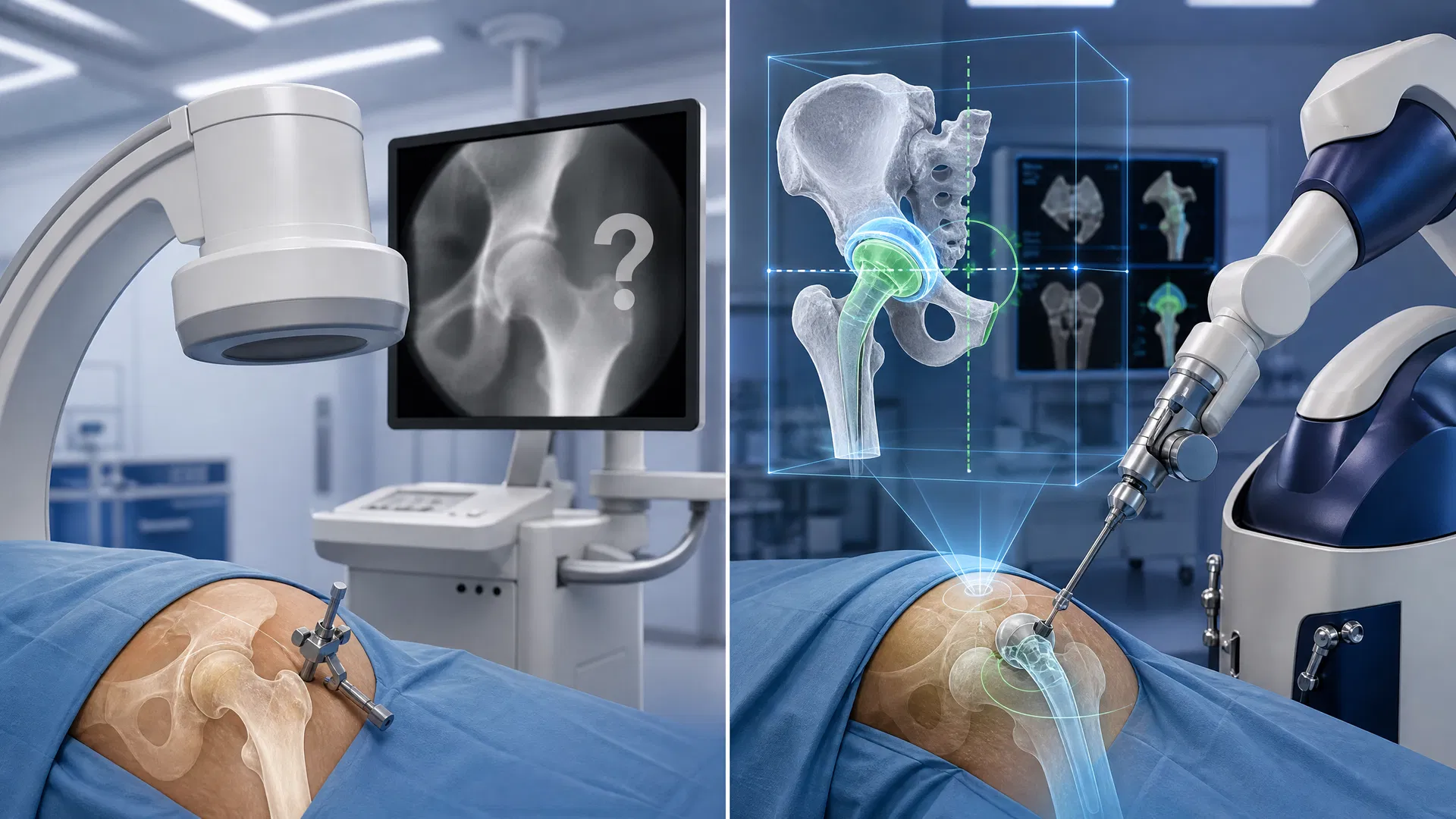
Fluoroscopy vs. Robotic Precision in Hip Replacement: What 3 Meta-Analyses Actually Show
Some surgeons market "live X-ray guidance" (intraoperative fluoroscopy) as a key advantage in hip replacement. But what does the peer-reviewed literature actually say? Three separate meta-analyses — covering over 5,000 patients — have concluded that intraoperative fluoroscopy does NOT improve acetabular cup positioning, does NOT reduce dislocation rates, and does NOT improve leg-length equality. Meanwhile, robotic-arm assisted surgery (MAKO) achieves cup placement accuracy within 1 degree of plan — a 5-fold improvement over manual techniques. Here's what patients need to know.
The Bottom Line
Intraoperative fluoroscopy (live X-ray) provides a 2D image that surgeons cannot accurately interpret for cup angles. Three meta-analyses confirm it does not improve implant positioning. CT-based robotic guidance provides 3D precision to within 1 degree — and eliminates radiation exposure to the patient and surgical team.
What Is Intraoperative Fluoroscopy?
Intraoperative fluoroscopy (IF) uses a C-arm X-ray machine during surgery to take live 2D images of the hip. Some surgeons use these images to estimate whether the acetabular cup (the socket component) is positioned at the correct angle. The theory is that seeing a real-time X-ray should help the surgeon place the implant more accurately.
The problem? A 2D X-ray image cannot reliably show 3D cup orientation. The angles change depending on where the X-ray beam is aimed, how the patient's pelvis is tilted, and how the surgeon interprets the image. Multiple studies have now confirmed this.
The Evidence: 3 Meta-Analyses Say Fluoroscopy Doesn't Help
Meta-Analysis #1: Sun et al., 2024
Medicine | 13 studies | 2,195 patients (2,207 hips)
This is the largest and most recent meta-analysis on the topic. The authors searched 10 medical databases and analyzed every available study comparing fluoroscopy vs. no fluoroscopy during total hip arthroplasty.
Results:
- Cup inclination angle: No difference (P = 0.9)
- Cup inclination within safe zone: No difference (P = 0.87)
- Cup anteversion angle: No difference (P = 0.42)
- Cup anteversion within safe zone: No difference (P = 0.35)
- Combined safe zone rate: No difference (P = 0.30)
- Limb length discrepancy: No difference (P = 0.13)
- Dislocation rate: No difference (P = 0.76)
- Operation time: Longer with fluoroscopy (P < 0.00001)
Conclusion: "IF did not demonstrate improvements in acetabular cup placement, limb length difference, or dislocation occurrence."Read Study
Meta-Analysis #2: Lecoultre et al., 2023
Arthroplasty | 10 studies | 1,394 patients
This meta-analysis from the journal Arthroplasty pooled data from 10 observational studies using random effects models.
Results:
"The current meta-analysis found no differences in cup positioning, offset, leg length discrepancy, the incidence of complications or revision surgery."
Meta-Analysis #3: Zhu et al., 2023
Journal of Orthopaedic Surgery and Research | 7 studies | 1,262 hips
Focused specifically on the direct anterior approach (DAA) — the same approach used in both fluoroscopy-guided and robotic-guided hip replacements.
Results:
- Cup inclination: No difference (P = 0.21)
- Inclination safe zone: No difference (P = 0.97)
- Cup anteversion: No difference (P = 0.26)
- Anteversion safe zone: No difference (P = 0.07)
- Combined safe zone: No difference (P = 0.33)
- Limb length discrepancy: No difference (P = 0.21)
Conclusion: "Intraoperative fluoroscopy was not related to an improvement in cup location."Read Study
Why Fluoroscopy Fails: Surgeons Can't Accurately Read the Images
A 2023 study from the Rothman Institute (one of the nation's top orthopedic centers) tested whether surgeons could accurately estimate cup angles from fluoroscopic images. The title says it all:
"Surgeon Estimations of Acetabular Cup Orientation Using Intraoperative Fluoroscopic Imaging Are Unreliable"
— Brush et al., Arthroplasty Today, 2023
The study found that surgeons' visual estimates of cup inclination and anteversion from fluoroscopy images were consistently inaccurate. This means even when a surgeon uses live X-ray, they cannot reliably tell if the cup is at 40° or 50° — a difference that matters for long-term implant survival.
Additional research has shown that the fluoroscopic beam angle relative to the pelvis dramatically changes the perceived cup position on the image. A cup that appears perfectly positioned from one angle can appear malpositioned from another — making it an inherently unreliable tool for precision placement.
2026 Study: About 4–5× Less Angular Error with Robotic Guidance
Unlike fluoroscopy (which shows a 2D shadow), the MAKO robotic system uses a preoperative CT scan to create a complete 3D model of the patient's hip anatomy. During surgery, the robotic arm provides real-time haptic (touch) feedback, physically guiding the cup into the exact planned position. The surgeon controls every movement — the robot simply prevents deviation from the plan.
Landmark 2026 Intra-Patient Study: Same Joint, Manual vs. Robotic
Journal of Robotic Surgery | 100 hips | Prospective design
This study used a unique design: in the same patient, same joint, the surgeon first manually impacted a trial cup and recorded its position, then removed it and placed the definitive cup using MAKO robotic guidance. This eliminates all patient-to-patient variability — the only variable is the guidance method.
Anteversion Error
P < 0.001 — 5x more accurate
Inclination Error
P < 0.001 — 3.7x more accurate
This evidence is so compelling that Stryker (the manufacturer of MAKO) has launched a formal "Journey to Fluoro-Free" initiative, encouraging surgeons to eliminate fluoroscopy entirely when using MAKO. The robotic system's CT-based 3D planning and AccuStop haptic technology provide superior accuracy without any radiation exposure to the patient or surgical team.
Head-to-Head: Fluoroscopy vs. MAKO Robotic Guidance
| Factor | Fluoroscopy (Live X-ray) | MAKO Robotic |
|---|---|---|
| Imaging Dimension | 2D (flat X-ray) | 3D (CT-based model) |
| Cup Positioning Accuracy | 3.8° – 4.63° error | 0.93° – 0.94° error |
| Improves Safe Zone Placement? | No (3 meta-analyses) | Yes (P < 0.01) |
| Radiation Exposure | Yes — patient & staff | None intraoperatively |
| Effect on OR Time | Increases (P < 0.00001) | Comparable or reduced |
| Surgeon Estimation Reliability | "Unreliable" (Brush 2023) | Haptic-guided, no estimation |
| Complication Rate Impact | No improvement (P = 0.76) | 51% fewer complications |
| Planning Method | Real-time visual guess | Pre-op CT with patient-specific plan |
A Note on "Bikini" Incisions: Cosmetic Marketing vs. Clinical Reality
Some practices market a horizontal "bikini" incision for anterior hip replacement as if it were a unique surgical technique. In reality, it is simply a cosmetic variation of the standard direct anterior approach — the same Smith-Peterson interval, the same muscle-sparing dissection. The only difference is whether the skin incision runs vertically (standard) or horizontally (bikini/cosmetic).
I use the bikini incision selectively — specifically when cosmesis is a priority or when wound healing considerations favor a horizontal incision (such as in patients with significant skin folds in the groin area). However, patients should understand the trade-offs:
Rothman Institute Study: Bikini Incision Outcomes in Revision (2024)
Journal of Arthroplasty | 6,771 DAA THAs | Single surgeon
This study from the Rothman Institute — one of the highest-volume anterior hip centers in the world — examined what happens when patients with a bikini incision need revision surgery within 90 days:
- 77.8% of bikini-incision patients needed additional operations after first revision vs. 16.9% with vertical incision
- 66.7% (6/9) of bikini revision patients required plastic surgery intervention vs. 3.1% (2/65) with vertical incision
- The bikini incision is "less forgiving" when extensile exposure is needed
This doesn't mean the bikini incision is "bad" — it means it's a cosmetic choice with real trade-offs, not a revolutionary technique. The incision direction has nothing to do with implant accuracy, recovery speed, or surgical precision. Those outcomes are determined by the surgeon's approach to the joint, the accuracy of implant placement, and the use of muscle-sparing techniques — all of which are enhanced by robotic guidance, not by which direction the skin is cut.
What Actually Determines Your Hip Replacement Outcome
What the Science Supports
- • CT-based 3D planning (patient-specific)
- • Robotic-guided cup placement (sub-degree accuracy)
- • Muscle-sparing approach (direct anterior)
- • Surgeon volume and experience
- • Proper soft-tissue balancing and leg-length restoration
- • Multimodal pain management protocol
What the Science Does NOT Support
- • Fluoroscopy improving cup positioning
- • Incision direction affecting recovery
- • "Branded" procedure names = better outcomes
- • Catchy marketing = clinical superiority
- • Concierge fees = better surgery
- • Avoiding proven technology (robotics)
The Hidden Cost of Fluoroscopy: Radiation Exposure
Beyond its lack of accuracy benefit, fluoroscopy exposes patients and the entire surgical team to ionizing radiation during every case. Research has documented:
- •Increased breast cancer risk in female orthopedic surgeons (Chou et al., 2016, JBJS)
- •77% of orthopedic surgeons report back pain from wearing lead aprons (Lucasti et al., 2022)
- •Lead apron integrity degrades over time, reducing protection (Kellens et al., 2022)
- •Bacterial contamination of lead garments documented in OR settings (Gilat et al., 2020)
With MAKO robotic guidance, there is zero intraoperative radiation. The only imaging is a preoperative CT scan (low-dose, done once before surgery). This protects the patient, the surgeon, the nurses, and the surgical techs — for every single case.
Frequently Asked Questions
Does live X-ray (fluoroscopy) make hip replacement more accurate?
No. Three separate meta-analyses (Sun 2024, Lecoultre 2023, Zhu 2023) covering over 5,000 patients have found that intraoperative fluoroscopy does not improve acetabular cup positioning, does not reduce dislocation rates, and does not improve leg-length equality compared to surgery without fluoroscopy. It does, however, increase operating time.
Is MAKO robotic hip replacement more accurate than fluoroscopy-guided surgery?
In a 2026 intra-patient study, robotic cup placement averaged approximately 0.9° from plan versus 3.5°–4.7° with manual placement—about four to five times less angular error in that study. These findings describe the study population and do not guarantee an individual result.
What is a "bikini incision" hip replacement?
A bikini incision is simply a horizontal skin incision (along the groin crease) instead of the standard vertical incision used in direct anterior hip replacement. It is a cosmetic variation — the underlying surgical approach, muscle-sparing technique, and implant placement are identical. Research from the Rothman Institute (2024) found that bikini incisions are "less forgiving" if revision surgery is needed, with significantly higher rates of additional operations and plastic surgery intervention compared to vertical incisions.
Does Dr. Lupo perform the direct anterior hip approach?
Yes. Dr. Lupo has performed the direct anterior approach for years and combines it with MAKO robotic guidance for sub-degree implant accuracy. He also uses the bikini incision selectively when cosmesis or wound healing is a priority. The key difference is that his approach adds CT-based 3D planning and robotic precision — something that fluoroscopy alone cannot provide.
Why do some surgeons still use fluoroscopy if it doesn't help?
Fluoroscopy was widely adopted before robotic technology became available. Many surgeons are comfortable with it and believe it provides reassurance, even though the data shows it doesn't improve outcomes. Additionally, robotic systems require significant investment and training. Stryker has launched a "Journey to Fluoro-Free" initiative specifically to help surgeons transition away from fluoroscopy to more accurate robotic guidance.
References
- Sun C, Gao H, Ma Q, et al. The effect of intraoperative fluoroscopy on acetabular component positioning and patient anatomy restoration during total hip arthroplasty: A systematic review and meta-analysis. Medicine. 2024;103(37):e39528.doi:10.1097/MD.0000000000039528
- Lecoultre J, et al. Intraoperative imaging in hip arthroplasty: a meta-analysis and systematic review. Arthroplasty. 2023;5:24.doi:10.1186/s42836-023-00173-8
- Zhu Y, et al. Does intraoperative fluoroscopy improve acetabular component positioning during direct anterior total hip arthroplasty? A meta-analysis. J Orthop Surg Res. 2023;18:577.doi:10.1186/s13018-023-04023-w
- Brush PL, Santana A, Toci GR, et al. Surgeon Estimations of Acetabular Cup Orientation Using Intraoperative Fluoroscopic Imaging Are Unreliable. Arthroplasty Today. 2023;20:101109.doi:10.1016/j.artd.2023.101109
- [2026 Intra-Patient Study]. Accurate acetabular component orientation: robotic vs manual impaction using intra-patient sequential design. J Robotic Surgery. 2026.doi:10.1007/s11701-026-03497-0
- Scholl LY, et al. Fluoroscopic vs robotic guidance in direct anterior THA: a single-surgeon comparison. J Arthroplasty. 2022;37(11):2267-2272.doi:10.1016/j.arth.2022.05.030
- [2024 Rothman Institute Study]. Vertical or Horizontal (Bikini) Incision for Direct Anterior Total Hip Arthroplasty: Outcomes of Early Revision. J Arthroplasty. 2024.doi:10.1016/j.arth.2024.05.078
- Stryker. "Join the Journey to Fluoro Free." Stryker Joint Replacement. 2024.stryker.com
Choose Evidence Over Marketing
Dr. Lupo combines the direct anterior approach with CT-based MAKO robotic guidance at AHN Saint Vincent Hospital in Erie. Published evidence can inform the discussion, but the recommended technique and outcome depend on the individual patient.