Robotic Hip Replacement vs. Traditional Surgery: What Patients Need to Know
If you're facing a hip replacement, you've probably heard about robotic surgery. But what does "robotic" actually mean in the operating room? Does it truly improve outcomes, or is it just marketing? As a fellowship-trained joint replacement surgeon who performs MAKO Muscle Sparing hip replacements daily, I want to give you the evidence-based answers — backed by data from over 30,000 procedures across multiple peer-reviewed studies.
The Bottom Line
Robotic-assisted hip replacement delivers 51% fewer complications, nearly 30% better implant accuracy, less blood loss, and patients report their hip feels more "natural" afterward — all without increasing infection risk. When combined with the Direct Anterior approach, patients walk the same day and go home within hours.
What Is Robotic Hip Replacement?
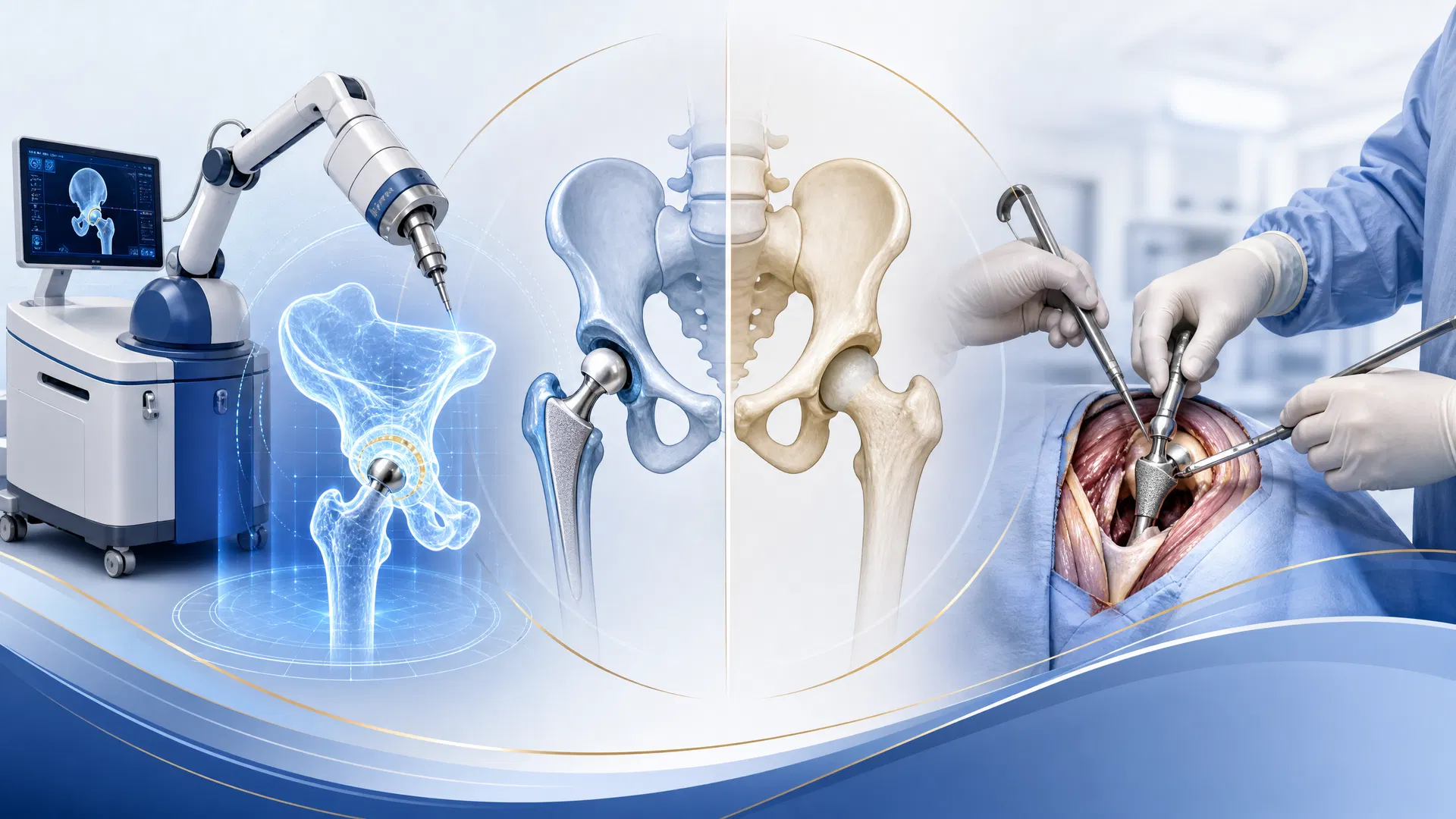
First, let's clear up a common misconception: the robot does not perform your surgery. I do. The MAKO robotic system is a sophisticated planning and guidance tool that helps me execute the surgical plan with sub-millimeter precision. Think of it as the difference between a pilot flying with instruments versus flying blind — the pilot still flies the plane, but the instruments make the flight safer and more precise.
Here's how it works: Before surgery, we obtain a CT scan of your hip. The MAKO system creates a patient-specific 3D model of your anatomy, allowing me to plan the exact size, position, and angle of your implant before we ever enter the operating room. During surgery, the robotic arm provides real-time haptic (touch) feedback — if I approach the boundary of the planned bone removal, the system physically resists, preventing me from cutting where I shouldn't. This protects surrounding bone, muscles, and soft tissue.
What Does the Research Say? The Evidence from 30,000+ Procedures
1. Implant Placement: Precision That Matters
The position of your hip implant determines everything — how natural it feels, how long it lasts, and whether it dislocates. A 2025 meta-analysis of 20 comparative studies found that MAKO robotic-assisted hip replacement placed 94.7% of implants within the ideal "safe zone" compared to just 65.8% with conventional techniques. [Loke et al., 2025]
That's nearly a 30-percentage-point improvement. When your implant sits in the correct position, it moves naturally, wears evenly, and dramatically reduces the risk of dislocation — the most feared complication after hip replacement.
2. Fewer Complications: 51% Reduction
A 2026 systematic review and meta-analysis of 15 studies found that robotic-assisted hip replacement demonstrated a clinically meaningful 51% reduction in overall perioperative complications compared with manual techniques — with low heterogeneity among studies, meaning the results were consistent across different research groups. [Aamir et al., 2026]
The researchers attributed this reduction to three factors: enhanced precision in component positioning, real-time haptic feedback preventing inadvertent bone damage, and improved soft tissue preservation. These are exactly the advantages I see in my operating room every day.
3. Less Blood Loss and Faster Discharge
A prospective study of 200 patients comparing MAKO robotic hip replacement to conventional surgery found that robotic patients had 30% less blood loss (hemoglobin drop of 2.49 vs. 3.38 g/dL), 60% fewer blood transfusions (8% vs. 20%), and 100% were discharged within 3 days — compared to 14% of conventional patients requiring extended hospitalization. [SICOT-J, 2024]
4. Your Hip Feels More Natural
Perhaps the most meaningful finding for patients: the "Forgotten Joint Score" — which measures how natural your new hip feels in daily life — was significantly better with MAKO robotic hip replacement (score improvement of 8.7 points, p=0.005). The Oxford Hip Score, measuring pain and function, was also significantly improved. [Loke et al., 2025]
In other words, patients with robotic hip replacements are more likely to "forget" they even have an artificial hip — which is exactly what we want.
5. Equal Leg Lengths
One of the most common complaints after traditional hip replacement is feeling like one leg is longer than the other. A meta-analysis of 8 randomized controlled trials (1,014 patients) found that robotic-assisted hip replacement achieved 4mm less leg-length discrepancy than conventional surgery. [Ruangsomboon et al., 2024]
Four millimeters may sound small, but patients can feel differences as small as 5mm — leading to back pain, gait problems, and dissatisfaction. The MAKO system's CT-based planning allows me to restore your natural leg length with precision that manual techniques simply cannot match.
6. No Increased Infection Risk
Some patients worry that a longer surgery means more infection risk. The largest study ever conducted on this question — presented at the 2026 AAOS Annual Meeting — analyzed 31,795 hip replacements (15,947 robotic, 15,848 conventional) and found no significant difference in infection rates. The robotic procedures added only 4.4 minutes of operative time on average. [AAOS 2026]
Head-to-Head Comparison: The Data
| Outcome Measure | MAKO Robotic | Traditional | Advantage |
|---|---|---|---|
| Implant in safe zone | 94.7% | 65.8% | Robotic |
| Complication reduction | 51% fewer | Baseline | Robotic |
| Blood transfusion rate | 8% | 20% | Robotic |
| Forgotten Joint Score | 84.7 | 74.9 | Robotic |
| Leg length discrepancy | 4mm less | Baseline | Robotic |
| Infection rate | 0.18% | 0.30% | No difference |
| Additional OR time | +4–8 min | Baseline | Minimal |
Data compiled from Aamir et al. 2026, Loke et al. 2025, SICOT-J 2024, Ruangsomboon et al. 2024, and AAOS 2026.
Why MAKO Muscle Sparing + Direct Anterior Is the Gold Standard
The data above compares robotic to traditional surgery — but the approach matters just as much as the technology. In my practice, I combine MAKO robotic precision with the Direct Anterior approach, which goes between the muscles rather than cutting through them. This MAKO Muscle Sparing technique delivers the best of both worlds:
- CT-planned precision — Your implant position is planned to the millimeter before surgery begins
- Zero muscles cut — The Direct Anterior approach goes between muscle planes, preserving every muscle around your hip
- Individualized precautions — Many direct anterior patients receive fewer approach-related restrictions, but instructions vary
- Same-day walking — Most patients walk within hours of surgery and go home the same day
- Haptic boundaries — The robotic arm physically prevents bone removal beyond the planned area, protecting healthy tissue
- Restored natural biomechanics — Equal leg lengths, proper offset, and optimal implant position mean your hip moves the way nature intended
Common Patient Questions
"Does the robot do the surgery?"
No. I perform every step of the surgery. The MAKO system is a planning and guidance tool — it creates a 3D map of your hip and provides real-time feedback during the procedure. The robotic arm assists my movements but cannot act independently. I am in complete control at all times.
"Is robotic surgery more expensive for me?"
In most cases, no. Robotic hip replacement is covered by Medicare and major insurance plans at the same rate as traditional hip replacement. The cost of the technology is absorbed by the hospital or surgery center, not passed to the patient.
"Is there a longer recovery because the surgery takes longer?"
The opposite is true. While robotic surgery may add 4–8 minutes of operating time, the precision it provides means less tissue damage, less blood loss, and faster recovery. The AAOS study of 31,795 hips confirmed that this minimal additional time does not increase infection risk. In experienced hands, robotic surgery can actually be faster — one study showed robotic procedures averaging 68 minutes vs. 77 minutes for conventional.
"What if something goes wrong with the robot during surgery?"
The MAKO system has multiple safety redundancies. If any issue occurs, I can seamlessly continue the surgery using conventional techniques — I am trained and experienced in both approaches. The robotic system enhances what I do; it does not replace my surgical skills.
"How long will my robotic hip replacement last?"
Modern hip implants are designed to last 20–30+ years. Because robotic-assisted surgery places the implant more precisely in the optimal position, there is reason to believe these implants may last even longer due to reduced wear. Long-term studies are ongoing, but early data is very encouraging — with revision rates comparable to or better than conventional surgery.
Why Surgeons Are Adopting Robotic Technology
The volume of robotic-assisted joint replacements increased 601% between 2015 and 2020, according to data presented at the 2026 AAOS Annual Meeting. This explosive growth isn't driven by marketing — it's driven by results. Surgeons who adopt robotic technology see more consistent outcomes, fewer complications, and higher patient satisfaction.
However, the technology is only as good as the surgeon using it. A robot cannot compensate for poor surgical technique or lack of experience. That's why it's important to choose a surgeon who is both fellowship-trained in joint replacement and experienced with the MAKO system — not someone who just started using it last month.
Scientific References
- Aamir M, et al. "Robotic-Assisted Total Hip Arthroplasty Compared With Manual Techniques: A Systematic Review and Meta-Analysis of Operative Time, Complications, and Functional Outcomes." Cureus. 2026;18(1):e102061. PMC12924498
- Loke RWK, et al. "MAKO robotic-assisted compared to conventional total hip arthroplasty for hip osteoarthritis: a systematic review and meta-analysis." J Orthop Surg Res. 2025;20:466. PMC12083021
- Kumar TJ, et al. "Robotic-assisted versus conventional hip arthroplasty: a comparative analysis of perioperative blood management and early outcomes." SICOT-J. 2024;10:59. DOI: 10.1051/sicotj/2024055
- Ruangsomboon P, et al. "Clinical, functional, and radiological outcomes of robotic assisted versus conventional total hip arthroplasty: a systematic review and meta-analysis of randomized controlled trials." J Robot Surg. 2024;18(1):255. PMC11189313
- Jolissaint J, et al. "Navigating Infection Risks: The Safety and Efficiency of Robotic Techniques in THA." Presented at AAOS Annual Meeting, March 2026, New Orleans. AAOS Press Release
- Ayers DC, et al. "Robotic-Assisted TKA Is Associated with Improved Quality of Life and Increased Patient Satisfaction One Year After Surgery." Presented at AAOS Annual Meeting, March 2026, New Orleans.
Ready to Learn If Robotic Hip Replacement Is Right for You?
Dr. Robert Lupo performs MAKO Muscle Sparing direct anterior hip replacement at AHN Saint Vincent Hospital in Erie. Call the office to discuss whether this approach may be appropriate for you.
Related Articles
The Direct Anterior Hip: Why Going Between the Muscles Changes Everything
Learn how the muscle-sparing Direct Anterior approach eliminates hip precautions and enables same-day recovery.
The Muscle-Sparing Approach to Total Knee Replacement
Discover how the subvastus approach preserves the quadriceps for faster knee replacement recovery.