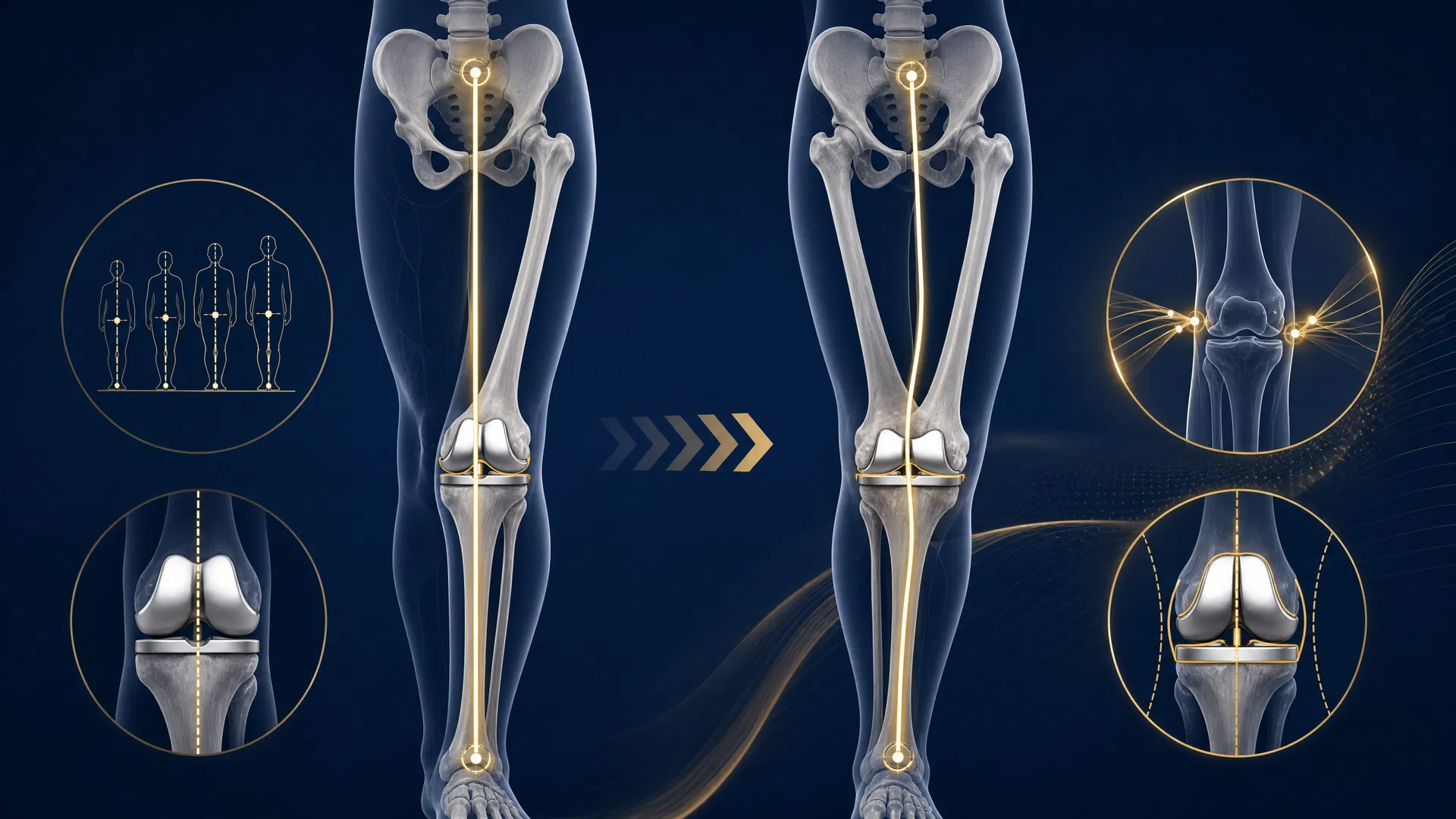
Direct Answer: Functional alignment in MAKO robotic knee replacement uses anatomy and ligament-balance information to guide implant positioning. In a matched study of 128 MAKO knee replacements, the functional-alignment group had 73% of patients reporting no residual symptoms, lower reported instability, and a higher Forgotten Joint Score than the mechanical-alignment group. Study findings do not guarantee an individual result.
The Problem: One-Size-Fits-All Knee Positioning
For over 40 years, surgeons have aligned every total knee replacement to a single "mechanical axis" — an imaginary straight line drawn from the center of the hip to the center of the ankle. The goal was simple: make the leg perfectly straight, regardless of what the patient's knee looked like before arthritis.
The problem? This approach often requires cutting or releasing ligaments to force the knee into a position it was never designed to be in. The result: up to 20% of patients remain dissatisfied after traditional knee replacement, reporting stiffness, instability, or a knee that "just doesn't feel right."
Why 1 in 5 Patients Are Dissatisfied
- •Mechanical alignment forces a generic position that ignores individual anatomy
- •Ligaments must often be released (cut) to make the knee fit the implant
- •The resulting knee feels "tight," "unstable," or "not like mine"
- •2D cutting guides cannot account for 3D soft tissue balance
The Solution: Functional Alignment with MAKO
Functional alignment flips the traditional concept: instead of forcing your knee to fit the implant, the implant is positioned to fit your knee's natural ligament balance. The goal is to restore the joint line and alignment that your knee had before arthritis — preserving the soft tissue envelope that gives your knee its natural feel.
This is fundamentally different from mechanical alignment. Rather than targeting a straight line on an X-ray, functional alignment targets how your knee actually works — the balance between your medial and lateral ligaments, the rotation of your femur, and the slope of your tibia. The result is a knee that "forgets" it was replaced.
How MAKO Makes Functional Alignment Possible
Functional alignment is a 3D process. It adjusts implant position simultaneously in the sagittal, transverse, and coronal planes. This cannot be achieved with 2D manual cutting guides, fluoroscopy, or non-CT-based systems. Here's why MAKO is the only platform that enables true functional positioning:
3D CT-Based Planning
Before surgery, a CT scan creates a precise 3D model of your unique anatomy. Dr. Lupo plans the exact implant position on this model — accounting for your bone shape, joint line, and natural alignment — before making a single cut.
Digital Tensioner (ICC ≥0.96 Repeatability)
During surgery, MAKO's Digital Tensioner objectively measures the tension in your medial and lateral ligaments with near-perfect repeatability (ICC ≥0.96). This real-time data tells the surgeon exactly how your soft tissues respond to different implant positions — no guessing.
AccuStop Haptic Boundaries
Once the optimal position is determined, MAKO's robotic arm constrains the saw within a patient-specific virtual boundary. The surgeon cannot accidentally cut outside the plan — ensuring sub-millimeter execution of the functional alignment strategy.
Real-Time Plan Adjustments
If the Digital Tensioner reveals that your ligaments respond differently than predicted by the CT plan, the surgeon adjusts the 3D plan intraoperatively — still within the robotic boundary system. The implant position adapts to your body, not the other way around.
Why Functional Alignment Cannot Be Achieved Manually
What the Research Shows
Functional vs. Mechanical Alignment with MAKO: Head-to-Head Comparison
Michaud et al., SICOT Journal, 2024 — 128 MAKO TKAs (64 functional vs. 64 mechanical)
No residual symptoms
(vs. 58% mechanical)
Less instability
(6.4% vs. 21.9%)
Forgotten Joint Score
(63.4 vs. 51.2)
- Forgotten Joint Score: 63.4 vs. 51.2 (p=0.034) — significantly better with functional alignment
- Oxford Knee Score: 40.8 vs. 34.9 (p=0.027) — significantly better
- Knee Society Score: 184.9 vs. 175.6 (p=0.02) — significantly better
- No ligament releases required in the functional alignment group
MAKO TKA Produces Better Functional Outcomes Than Manual Surgery
Bone & Joint Open, 2025 — Meta-analysis of 22 studies, 3,738 TKAs
- Medium-term Forgotten Joint Score: MD 5.50 favoring MAKO (95% CI 2.19–8.81) — statistically significant
- Pooled PROMs at medium-term: SMD 0.46 favoring MAKO (95% CI 0.22–0.70) — significant
- Pooled PROMs at long-term: SMD 0.40 favoring MAKO (95% CI 0.13–0.66) — significant
This is the largest meta-analysis to date on MAKO TKA outcomes. It confirms that the functional advantages are not just short-term — they persist at medium and long-term follow-up.
View Full StudyKinematic/Functional Alignment: Higher Satisfaction Than Mechanical
Cureus Systematic Review, 2025 — 12 studies comparing kinematic vs. mechanical alignment
- Higher patient satisfaction with kinematic/functional alignment across multiple outcome measures
- Better Forgotten Joint Scores — patients more likely to "forget" their knee was replaced
- No increase in complications — functional alignment is as safe as mechanical alignment
MAKO: The Only Robotic System Proven in the World's Largest Registry
Australian Orthopaedic Association National Joint Replacement Registry, 2024
- 19% relative improvement in 6-year revision rates vs. manual surgery
- 30% relative improvement when implanted with a patella resurfacing
- No other robotic system achieved a statistically significant improvement — only MAKO
The Australian Registry is the world's largest and most respected joint replacement database. MAKO's ability to execute functional alignment with sub-millimeter precision is the likely driver of these superior survivorship results.
What This Means for You as a Patient
When Dr. Lupo performs your knee replacement using MAKO with functional alignment, the process looks fundamentally different from a traditional approach:
A CT scan maps your unique anatomy in 3D. Dr. Lupo plans the exact implant position to restore YOUR natural alignment.
The Digital Tensioner measures your specific ligament tension. The plan adjusts to preserve your soft tissue envelope — no releases.
AccuStop haptic boundaries ensure the plan is executed within sub-millimeter accuracy. No deviation, no guessing.
In a matched study of 128 MAKO knees, 73% of the functional-alignment group reported no residual symptoms.
Frequently Asked Questions
What is the difference between functional alignment and mechanical alignment?+
Is functional alignment the same as kinematic alignment?+
Can any surgeon perform functional alignment?+
Will my knee feel different with functional alignment?+
Is functional alignment safe? Are there more complications?+
Does Dr. Lupo use functional alignment for all knee replacements?+
Key Takeaways
- 1Traditional mechanical alignment forces a generic position — up to 20% of patients remain dissatisfied.
- 2In a matched study of 128 MAKO knees, 73% of the functional-alignment group reported no residual symptoms.
- 3MAKO supports this 3D workflow through CT-based planning, ligament-balance information, and surgeon-controlled robotic guidance.
- 4MAKO is the only robotic system proven in the Australian Registry to improve revision rates vs. manual surgery.
- 5Patients score significantly higher on the Forgotten Joint Score — meaning the knee feels more natural.
References
- Michaud J, et al. Short-term functional outcomes of robotic-assisted TKA are better with functional alignment compared to adjusted mechanical alignment. SICOT-J. 2024;10:3. PMC10798231
- Robotic-assisted total knee arthroplasty with MAKO is associated with improved functional outcomes: a meta-analysis of 22 studies. Bone & Joint Open. 2025;6(11). BJO 2025
- Functional outcomes and patient satisfaction in kinematic vs mechanical alignment total knee arthroplasty: a systematic review. Cureus. 2025;17(3). Cureus 2025
- Kafelov M, et al. Functional positioning principles for image-based robotic-assisted TKA achieved a higher Forgotten Joint Score at 1 year compared to conventional TKA. Knee Surgery, Sports Traumatology, Arthroscopy. 2023.
- Australian Orthopaedic Association National Joint Replacement Registry. Annual Report 2024. Hip, Knee & Shoulder Arthroplasty.
- Lustig S. The promising clinical outcomes of functionally aligned total knee arthroplasty. AOF Foundation Review. 2024.
Is Functional Alignment Right for You?
If you're considering a total knee replacement and want a knee positioned specifically for your body — not a generic template — schedule a consultation with Dr. Lupo. He'll review your imaging, assess your ligament balance, and explain how MAKO's functional alignment applies to your unique anatomy.